News
You Can Hire Security Guards Cheap But It'll Cost You Later!
Hiring cheap security guards can backfire. Discover the hidden cost / risk before you decide. Learn what quality security really saves you.
Written by Alliance Security
Published · Updated · 9 min read
Why hire security guards in the first place?
A quick note on terms before we go further: most people search for “security guards” or “security guard services,” and that’s exactly what you get, but in the industry itself, the correct term is usually “manned guarding.” It’s the same service, uniformed, SIA-licensed officers deployed to protect a site, and you’ll see all these terms used throughout this article. If you’re comparing providers, “manned guarding” on a quote or contract means the same thing as “security guard services”.
A few reasons come up again and again: deterring theft and crime before it happens, protecting staff and the public, meeting your duty of care as an employer, and satisfying insurers who increasingly expect evidence of proper security measures.
Then there’s Martyn’s Law. The Terrorism (Protection of Premises) Act 2025 is expected to come into force in Spring 2027, requiring publicly accessible premises and events with 200+ capacity to have documented counter-terrorism preparations, with heavier obligations above 800 capacity.
We covered this in more detail in our earlier post on Martyn’s Law. Guidance is still being finalised, but the direction is clear: what’s optional today may be compulsory within 18 months. Getting a properly licensed, properly resourced provider in place now beats scrambling to catch up later.
With that context, here’s what hiring security guards actually costs, why prices keep climbing, and why paying properly for it is one of the smarter decisions a business can make.
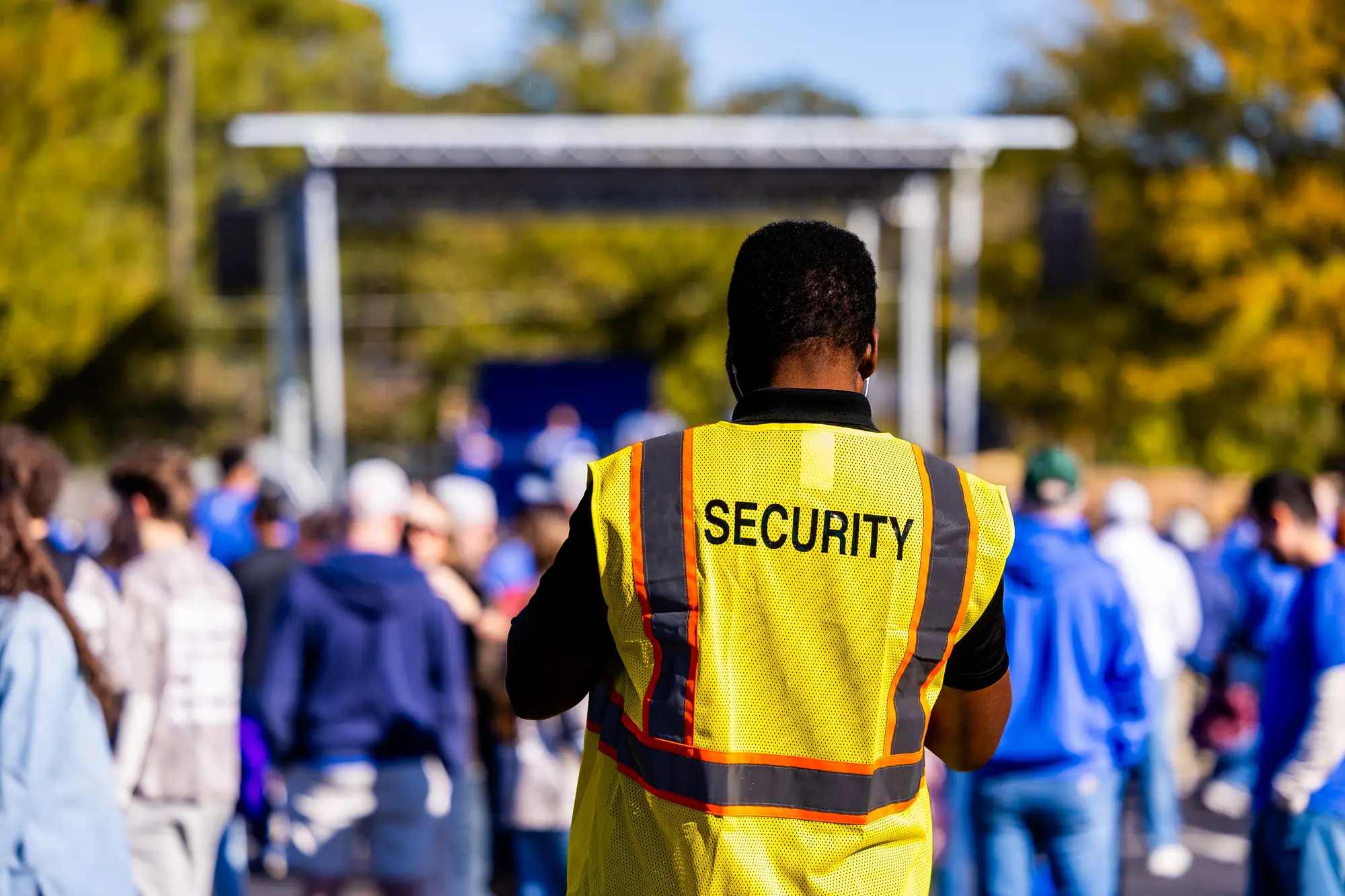
Hiring security guards typically costs £14–£19 per hour for day shifts and £16–£23 per hour for nights in the UK, with London rates running 40–50% higher. That cost is small next to what happens if you get it wrong: an unlicensed guard on your premises is a criminal offence that can land on you, not just your provider, and a single serious incident can wipe out years of savings in one afternoon: stock gone, staff hurt, insurance disputed, your name in the local paper. Cutting corners on security isn’t a way to save money. It’s a way to gamble with money you don’t have to lose.
Security costs have been climbing, and it’s tempting to look for savings there first. That’s exactly the mistake that catches businesses out, because every rising cost, licensing, wages, training, is exactly what a corner-cutting provider is quietly skipping to undercut you on price. The question isn’t whether you can find security cheaper. You can, easily. The question is what you’re actually left exposed to when you do.
Manned guarding cost: what’s actually driving it up
1. SIA licence cost
The SIA licence cost rose to £204 from 1 April 2026, after the historic £20 rebate was removed. This SIA licence cost is typically passed through by providers of manned guarding services, and it reflects the price of running the regulatory system that keeps unlicensed, unvetted individuals off your premises in the first place.
Here’s what that SIA licence cost is actually buying you: certainty that the person guarding your building, your staff and your stock isn’t operating illegally. Under the Private Security Industry Act 2001, deploying an unlicensed guard is a criminal offence, and that liability doesn’t stop at the provider’s door. It can land on the business that hired them. Whatever a provider quotes you, it’s worth asking directly how the SIA licence cost is factored into their pricing, since a supplier who can’t answer that clearly may not be covering it at all.
2. Wage growth and employer National Insurance
Security is a labour-intensive sector, so payroll changes hit hard. The National Living Wage rose to £12.71 per hour from April 2026, a 4.1% increase. At the same time, employer National Insurance Contributions rose from 13.8% to 15% from April 2025, and the threshold at which employers start paying it was lowered from £9,100 to £5,000 a year. Combined, analysis from Forvis Mazars suggests most employers are looking at something closer to a 10% rise in total employment cost per worker once wages, NICs, pension contributions and statutory sick pay are all factored in. For a manned guarding contract built entirely on officer headcount, that increase flows straight through to the hourly rate.
3. Rising training and qualification standards
The SIA’s 2026 Strategic Review, described by the regulator as a “strategic reset” for the industry, is pushing new officers toward qualifications built around safety-critical skills like counter-terrorism awareness, behavioural detection and incident response, rather than baseline compliance. This is partly being driven by Martyn’s Law, covered above. Better-trained officers cost more to bring into the industry, but they’re also the ones actually equipped to deliver the kind of protective measures venues will increasingly be expected to show.
None of this is padding. A quote that seems unusually cheap isn’t a good deal, it’s a warning sign that someone in that chain isn’t getting paid properly, licensed properly, or trained properly. You just don’t find out which until it’s too late.
How much does a security guard cost? What makes up the hourly rate
It helps to see where the money in a typical manned guarding quote actually goes when you break down the cost of security guard services line by line. Using a representative day-rate example around £17/hour as a guide:
| Cost component | Approx. share of rate | What it covers |
|---|---|---|
| National Living Wage pay | ~55–60% | Base officer pay at £12.71/hr or above, depending on role and experience |
| Employer NIC & statutory costs | ~10–12% | NICs at 15%, pension contributions, holiday pay, statutory sick pay |
| SIA licence cost & training | ~5–8% | SIA licence fee (£204), vetting (e.g. BS7858 screening), induction and refresher training |
| Supervision & management | ~10–12% | Site supervision, scheduling, incident reporting, quality checks |
| Uniform, equipment & insurance | ~5–7% | PPE, radios, employer’s liability and public liability cover |
| Provider margin | ~5–10% | Business overheads and reasonable profit |
The exact split varies by provider and contract, but the pattern holds. The majority of the rate is pay and statutory employment costs, not profit. A provider quoting well below this range for genuinely SIA-licensed, properly employed officers is either absorbing a loss, cutting corners somewhere in this table, or both.
| Area | Typical day rate | Typical night rate | Notes |
|---|---|---|---|
| Central/Greater London | £20–£28/hr | £23–£32/hr | 40–50% premium reflects wage costs, transport and site density |
| Surrey & Berkshire | £15–£20/hr | £17–£24/hr | Close to national average; varies by site risk |
| Hampshire, Kent, Essex | £14–£19/hr | £16–£23/hr | National average band |
| Hertfordshire & Bucks | £15–£20/hr | £17–£23/hr | Slight London-commuter-belt premium in places |
| East & West Sussex | £14–£19/hr | £16–£22/hr | Often well served by mobile patrols outside dense town centres |
These are indicative market ranges, not quotes

Want a real number before you hire security guards?
We give a free, no-obligation quote, with no hidden fees, so you can find out whether you're actually paying for protection, or just a name on an invoice.
GET IN TOUCHWhat Happens When You Don't Hire Security Guards
This isn't a hypothetical, and it isn't rare. It's already happening to businesses across the region right now, and the numbers behind it are bigger than most people expect.
A single serious incident (theft, break-in, an assault on staff, or a safeguarding failure at a school or healthcare site) doesn't just cost money. It costs trust, staff who no longer feel safe coming to work, customers who don't come back, and headlines you can't undo. Wherever in the region it happens, it will almost always cost more than a year of proper guarding would have. By then, it's too late to decide the guarding was worth it after all.
- Greater London alone recorded over 154,000 commercial burglaries in the most recent reporting period, according to Metropolitan Police data, one of the clearest signals that this isn't a rare, one-off risk for city-based businesses.
- Retail crime alone cost UK shops over £1.9 billion in a recent 12-month period, according to the British Retail Consortium, a figure that includes theft, violence and the operational disruption that follows, and retail-heavy high streets across Surrey, Kent and the wider Home Counties are far from immune.
- Around 8% of UK business premises experience burglary or attempted burglary, according to the ONS Commercial Victimisation Survey, with retail and wholesale among the most affected sectors, a risk that applies just as much to a business park in Berkshire or Hertfordshire as it does to central London.
How to Hire Security Guards and Actually Get Value, Not Just a Lower Price
Value for money isn't the same as the lowest quote. A few things are worth checking to make sure the spend is actually working for you:
- Confirm officers are properly licensed. An SIA licence check against the register of SIA licence holders on GOV.UK is free, takes under a minute, and should happen before any officer sets foot on your site, not after something's gone wrong.
- Ask what's included beyond the hourly rate: supervision, reporting, incident response protocols and training standards all affect whether you're getting a robust service or just a body on site.
- Match the deployment to your actual risk, not a generic package. A proper risk assessment should determine whether you need static guarding, mobile patrols, reception-based security, or a mix.
- Review regularly. Risk profiles, footfall and threats change. A service that was right-sized two years ago may not be today.
The Bottom Line on Hiring Security Guards
Security costs are rising, and it's entirely reasonable to want to understand why before signing off the spend. But judged against the real financial and operational cost of an incident (not just the invoice), properly resourced manned guarding is genuinely one of the best-value risk management decisions a business can make. It's not a line item to shrink when budgets tighten; it's the line item that stops a bad month becoming a bad year. The goal isn't to spend the least on security. It's to spend appropriately for the risk, with a provider you can verify is doing things properly, so the investment actually holds up when it's tested.
Frequently Asked Questions
Is manned guarding worth the cost for a small business?It depends on risk exposure, but for premises handling cash, stock, or public access, the cost of manned guarding is typically small relative to the potential cost of a single theft, break-in or incident, particularly once lost trading time and reputational impact are included.
Why has security guarding become more expensive in 2026?Rising costs reflect the SIA licence fee increase to £204 from April 2026, wage growth tied to the National Living Wage, and increasing training and qualification standards across the industry, all of which support a more professional, accountable workforce.
Does manned guarding actually prevent crime, or just respond to it?Visible, trained security officers are widely considered a stronger deterrent than technology alone, since a camera or alarm typically detects or records an incident rather than stopping it before it happens.
How do I know if I'm getting good value from a security provider, not just a cheap price?Check that officers are SIA-licensed (verifiable for free on the official register), confirm the deployment matches a genuine risk assessment rather than a generic package, and ask what supervision, reporting and training standards are included beyond the hourly rate.
What's the real cost of not having adequate business security?UK retail crime alone was estimated to cost businesses over £1.9 billion in a recent 12-month period, and roughly 8% of UK business premises experience burglary or attempted burglary each year, costs that often exceed what proper security would have cost to prevent them.
How do I do an SIA licence check before hiring a security provider?Go to the register of SIA licence holders on GOV.UK and search using the officer's 16-digit licence number, or their name and date of birth. It's free, takes under a minute, and is the only reliable way to confirm a licence is genuine and current. A badge alone isn't enough, since it can look valid even if the licence behind it has been suspended.
Is security more expensive in London than the Home Counties?Generally, yes. London rates typically run 40–50% higher than elsewhere in the UK, reflecting higher wage costs and the density of high-risk commercial sites. Pricing across Surrey, Berkshire, Hampshire, Hertfordshire, Kent and the wider Home Counties tends to sit closer to the national average, though it still varies by site risk and the type of coverage needed.